The Highway Cometh
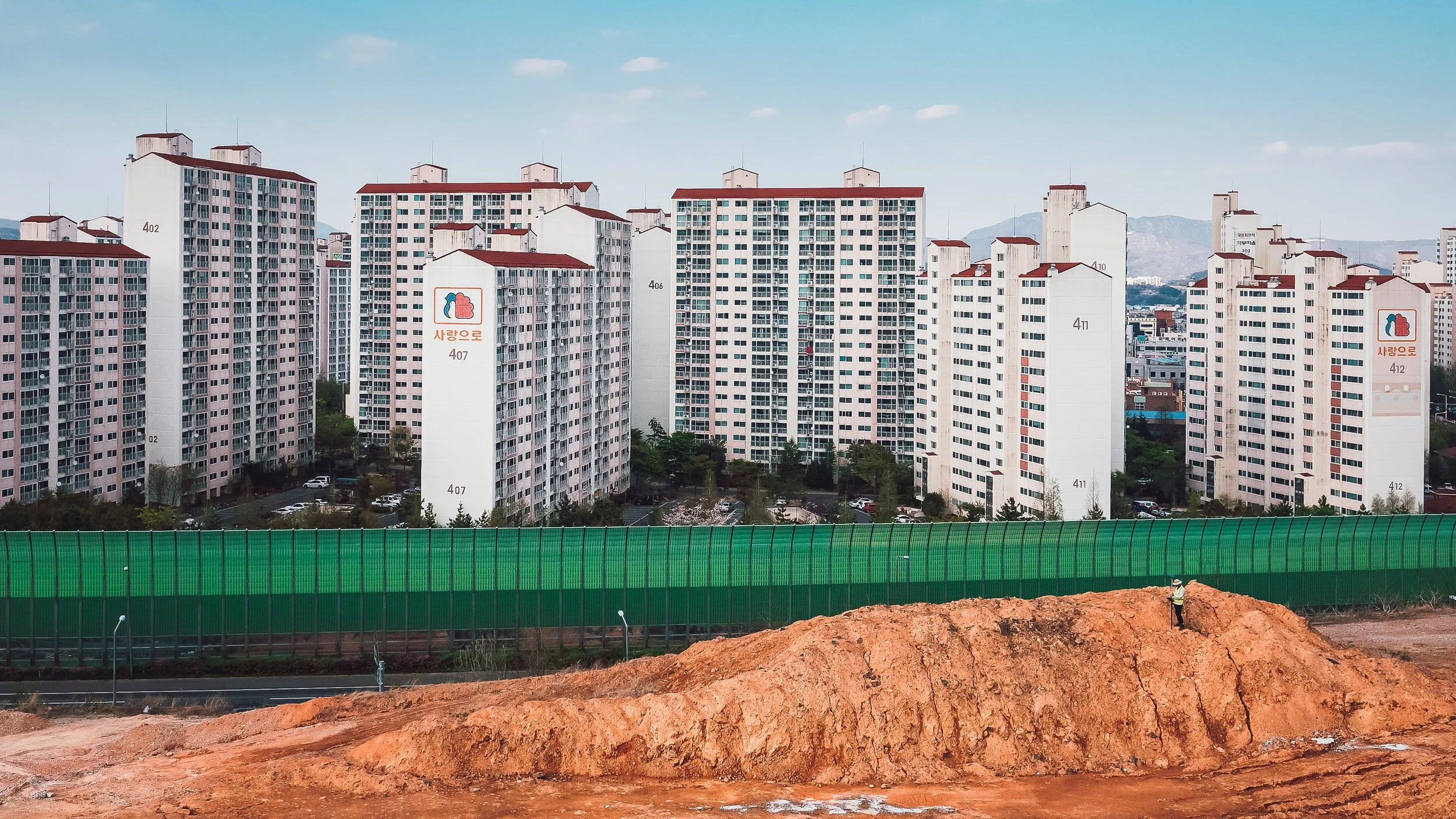
The path of bare red earth ran out, the scrappy pines and wild azaleas thinned and I emerged at a viewpoint, gazing at a panorama of near-identical, cream-coloured apartment blocks. Each was numbered (402…407…411); some bore a huge and colourful bird motif. Once, presumably, there’d been a pleasing vista of town buildings and distant paddies and peaks from where I stood, but that bird had flown. My gaze shifted downward to the foreground, where
Image Date: 12 April 2013
The path of bare red earth ran out, the scrappy pines and wild azaleas thinned and I emerged at a viewpoint, gazing at a panorama of near-identical, cream-coloured apartment blocks. Each was numbered (402…407…411); some bore a huge and colourful bird motif. Once, presumably, there’d been a pleasing vista of town buildings and distant paddies and peaks from where I stood, but that bird had flown. My gaze shifted downward to the foreground, where a surveyor was absorbed in his work atop a sprawling mini-mountain of red clay.
The Highway Cometh, Jangyu, South Korea, 2013
The town was Jangyu, in Korea’s South Gyeongsang Province, my home in 2012 and 2013. Jangyu was described at the time as a “new town”, and the few old houses I came across during my incessant journeying in the area were abandoned and decaying. Most of the residents lived in these clustered, numbered apartment towers, but Korea, like Japan, is extremely mountainous. I soon found myself - in more ways than one - spending my workday afternoons in the forested hills that dotted the area, then weekends in the larger mountains beyond. I was trying to put the draining days in overcrowded classrooms behind me, but I had also just received my first “real” lens (a Zeiss 24mm) in the mail, a partner for my first “real” camera, the tiny, mirrorless Sony NEX I’d bought just before leaving Australia. Those blessed hills, and the farmland in the valleys between them, saved me from complete misery.
There are perhaps three levels of contrast in this picture. There’s the horizontal force of the fence and the dirt pile Vs the skyward lines of the towers. There’s the colour contrast of the red earth Vs the green highway barrier. And then there’s the startling juxtaposition of all that ordered modernity in the background with the mess of the highway construction at the front. That tiny human near the summit of Dirt Mountain seems to be valiantly trying to make sense of it all.
I was trying as well. It was none of my business, but during those two years of aimless wandering I stumbled across so many construction and highway projects, so many “developments” in former farmland or mountains carved up for roads, that documenting all that environmental destruction and the loss of natural landscape became a sort of personal photographic passion project. Korea with its 50-odd-million residents seemed a tiny country, and it felt like it was getting smaller before my eyes. I felt lost for much of my time there, but I wasn’t, really. I just didn’t know where I was for a couple of years.