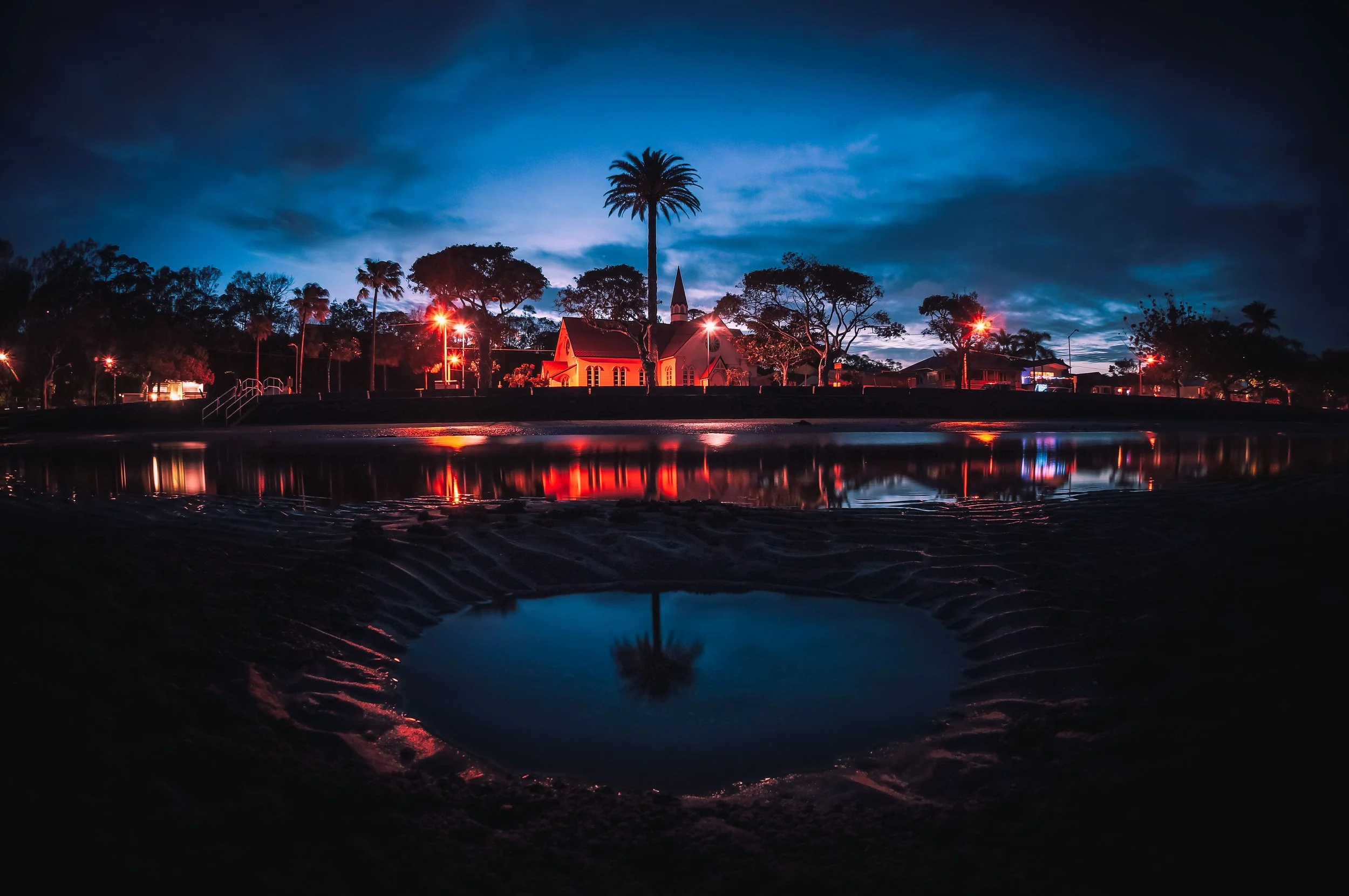
Twilight Reflections in a Stingray Hole
I came to call them mudflat meditations, the hour-long rambles I enjoyed early each morning for several years, tides permitting, across the rippled tracts of wet sand on the Sandgate foreshore. A 7-11 coffee-and-muffin combo on a waterfront bench, the glow of an emerging sun behind Moreton Island on the eastern edge of the bay, and my morning commute would begin. Shoes off, I was soon descending from the seawall to venture out, splashing through the tidal ponds of a freshly remodelled landscape, camera in hand, till the sun was bright. But this time
Image Date: 23 December 2014
I came to call them mudflat meditations, the hour-long rambles I enjoyed early each morning for several years, tides permitting, across the rippled tracts of wet sand on the Sandgate foreshore. A 7-11 coffee-and-muffin combo on a waterfront bench, the glow of an emerging sun behind Moreton Island on the eastern edge of the bay, and my morning commute would begin. Shoes off, I was soon descending from the seawall to venture out, splashing through the tidal ponds of a freshly remodelled landscape, camera in hand, till the sun was bright. But this time, for reasons I can’t recall, my ritual was beginning in early evening.
Twilight Reflections in a Stingray Hole, Sandgate, Brisbane, 2014
2014 was the year my occasional forays onto the flats became an essential part of each day, as necessary as breakfast or sleep. In July, as my relationship with an overseas girlfriend was breaking down, I was accused, falsely, of nefarious visa intentions, locked up with a dozen strangers in a backroom airport cell for 12 hours, and escorted by armed goons onto a plane and from her country. A relapse into functional depression followed. Prescribed mild antidepressants, I’d spend hours daily meandering along the waterfront in a vaguely pleasant (at first) haze of numbness. The mudflats were a place of solace and quiet drama. Soldier crabs scurried and tunnelled; seabirds foraged and fished. The turning tide carved fresh channels in its journey shoreward, seeping into and flooding the countless hundreds of stingray lies remaining from the previous high tide.
This was a rare evening mudflat image for me - after the magic of golden and then blue hours, you’re walking in ever-deepening darkness, photographic opportunities dry up, and there’s always the risk of tripping in one of those infernal fish holes! I used the tiny Sony NEX (probably my first, the 5N) and a small, plastic Gorillapod. A long exposure was required; from memory it was five seconds. Any longer and a tripod leg might start to sink. I love that I was able to capture the palm tree reflection, the sharp detail of the old Baptist church on the shore, and a suggestion of the contoured perimeter of the stingray lie. The blue of the sky and the captured seawater (a valuable habitat for juvenile prawns and fish) also rendered well, and I brought out its richness in my edit.
But mostly I enjoy the image of the rays (probably the estuary stingray, Hemitrygon fluviorum) quietly going about their timeless hunting strategy beyond the view of the humans on shore; squadrons of them gliding over the seabed, stirring up the sand with their winglike fins to expose the soldier crabs and worms they seek. Two worlds, side by side, each oblivious to the existence of the other.
The Highway Cometh
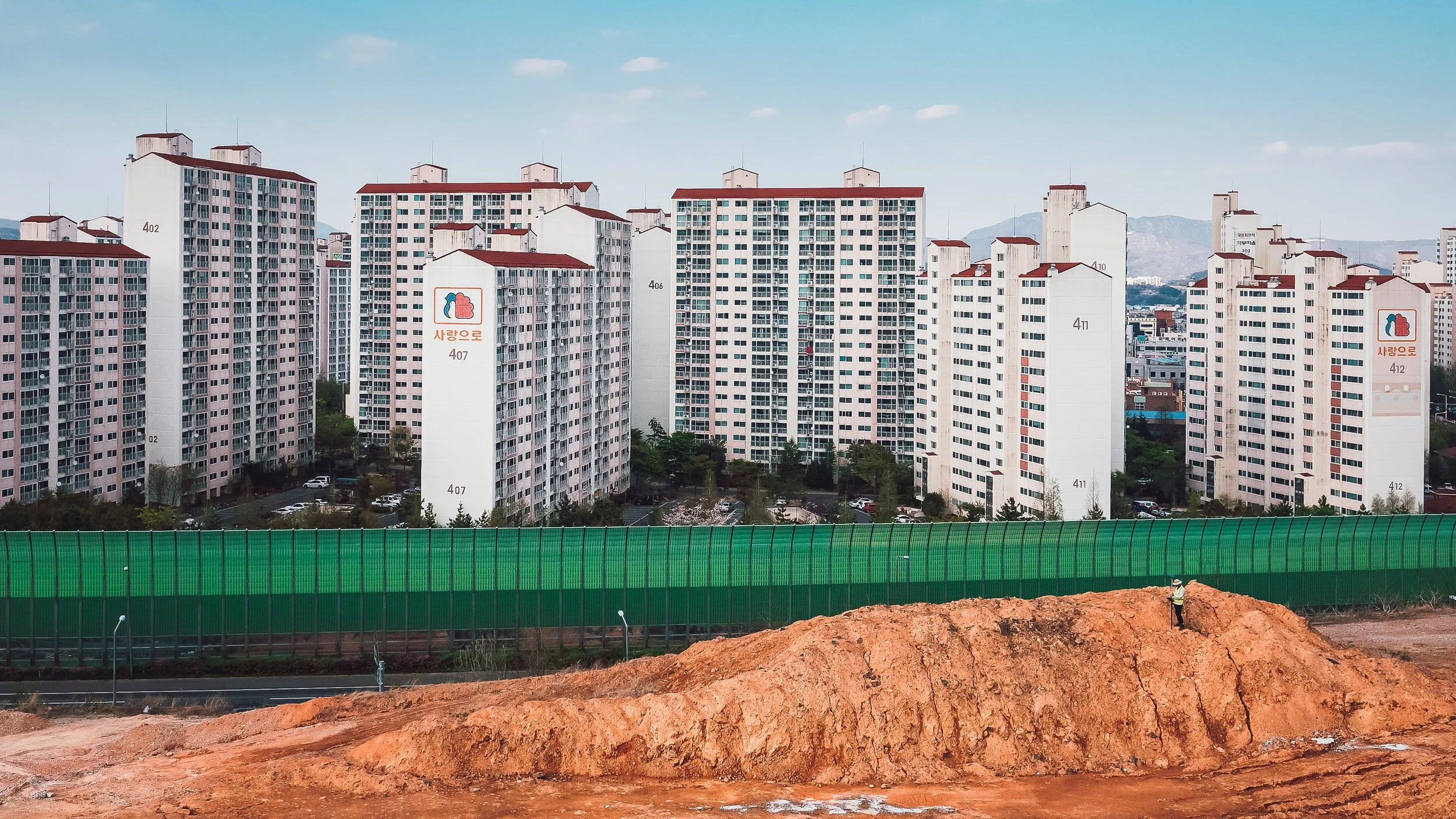
The path of bare red earth ran out, the scrappy pines and wild azaleas thinned and I emerged at a viewpoint, gazing at a panorama of near-identical, cream-coloured apartment blocks. Each was numbered (402…407…411); some bore a huge and colourful bird motif. Once, presumably, there’d been a pleasing vista of town buildings and distant paddies and peaks from where I stood, but that bird had flown. My gaze shifted downward to the foreground, where
Image Date: 12 April 2013
The path of bare red earth ran out, the scrappy pines and wild azaleas thinned and I emerged at a viewpoint, gazing at a panorama of near-identical, cream-coloured apartment blocks. Each was numbered (402…407…411); some bore a huge and colourful bird motif. Once, presumably, there’d been a pleasing vista of town buildings and distant paddies and peaks from where I stood, but that bird had flown. My gaze shifted downward to the foreground, where a surveyor was absorbed in his work atop a sprawling mini-mountain of red clay.
The Highway Cometh, Jangyu, South Korea, 2013
The town was Jangyu, in Korea’s South Gyeongsang Province, my home in 2012 and 2013. Jangyu was described at the time as a “new town”, and the few old houses I came across during my incessant journeying in the area were abandoned and decaying. Most of the residents lived in these clustered, numbered apartment towers, but Korea, like Japan, is extremely mountainous. I soon found myself - in more ways than one - spending my workday afternoons in the forested hills that dotted the area, then weekends in the larger mountains beyond. I was trying to put the draining days in overcrowded classrooms behind me, but I had also just received my first “real” lens (a Zeiss 24mm) in the mail, a partner for my first “real” camera, the tiny, mirrorless Sony NEX I’d bought just before leaving Australia. Those blessed hills, and the farmland in the valleys between them, saved me from complete misery.
There are perhaps three levels of contrast in this picture. There’s the horizontal force of the fence and the dirt pile Vs the skyward lines of the towers. There’s the colour contrast of the red earth Vs the green highway barrier. And then there’s the startling juxtaposition of all that ordered modernity in the background with the mess of the highway construction at the front. That tiny human near the summit of Dirt Mountain seems to be valiantly trying to make sense of it all.
I was trying as well. It was none of my business, but during those two years of aimless wandering I stumbled across so many construction and highway projects, so many “developments” in former farmland or mountains carved up for roads, that documenting all that environmental destruction and the loss of natural landscape became a sort of personal photographic passion project. Korea with its 50-odd-million residents seemed a tiny country, and it felt like it was getting smaller before my eyes. I felt lost for much of my time there, but I wasn’t, really. I just didn’t know where I was for a couple of years.
Pilgrim in the Mist
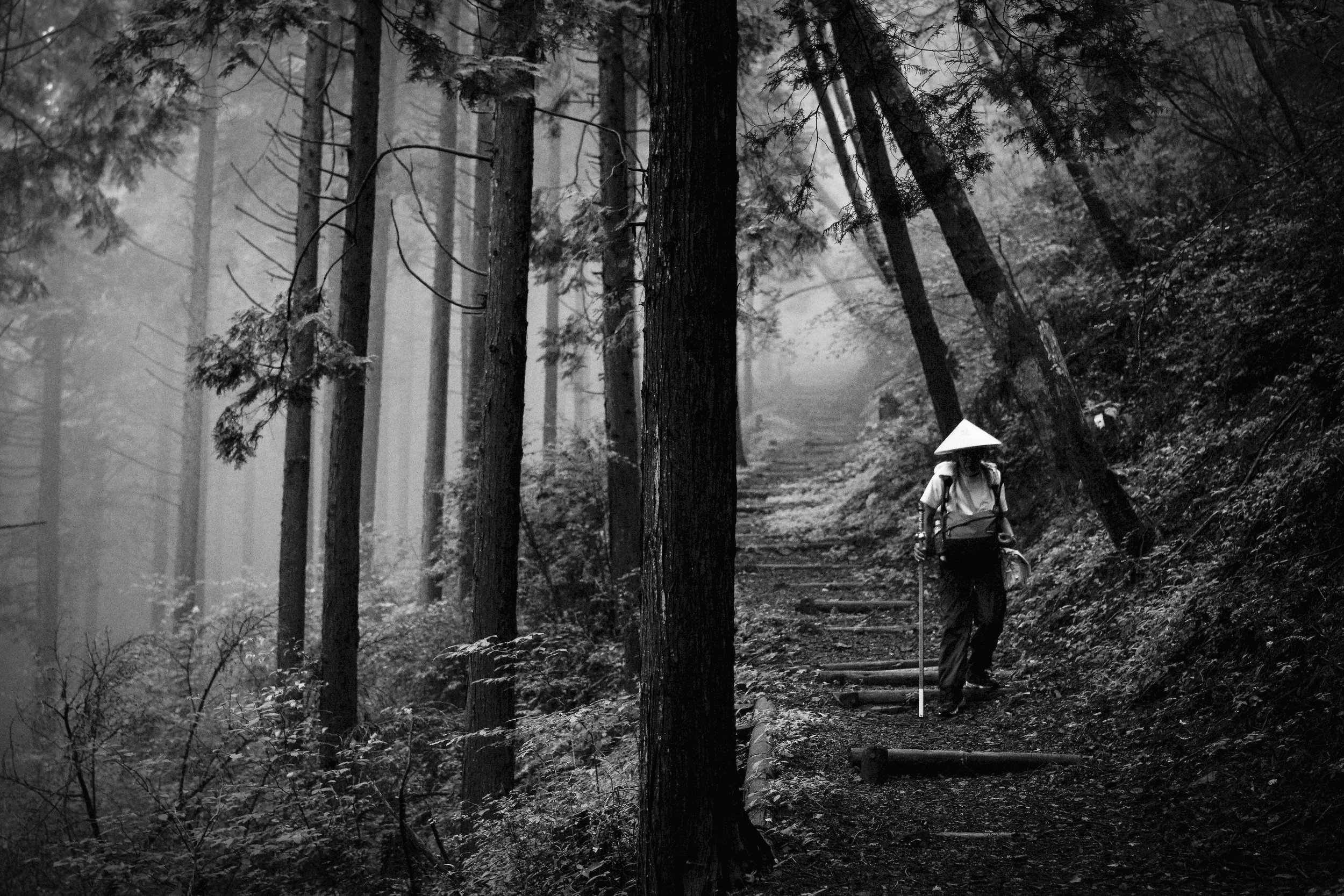
It was early morning but already hot; sky murky, air heavy and moist. Remnant mist clothed the trunks and trail further up the mountain. I’d barely begun the climb up the pilgrim path, and had already paused to take a breath beneath the slender trunks of cedar. I was scanning the trees to the left through my viewfinder, framing a section of fog-shrouded forest, when a flash of white on the periphery startled me. I swung the camera right.
Image Date: 4 September 2015
It was early morning but already hot; sky murky, air heavy and moist. Remnant mist clothed the trunks and trail further up the mountain. I’d barely begun the climb up the pilgrim path, and had already paused to take a breath beneath the slender trunks of cedar. I was scanning the trees to the left through my viewfinder, framing a section of fog-shrouded forest, when a flash of white on the periphery startled me. I swung the camera right.
Pilgrim in the Mist, Tokushima, 2015
The henro-san (pilgrim) was descending from the direction of Unpenji, (雲辺寺; usually translated as “Hovering Clouds Temple”), my destination that humid late-summer morning. I try to avoid obtrusively photographing pilgrims and other people I encounter on walks, but this gentleman had unknowingly provided the key element in a nice composition, and my racing heartbeat jolted me from my worn-out, sleep-deprived torpor. I swung the camera left again, just a tad; the lens was wide enough to capture both the vastness of the forested slope and the human venturing through it not far from the edge of the frame. He was dwarfed by the primeval gloom of the mountain forest, but his white T-shirt and pilgrim hat lent his figure a certain presence.
This is a picture I love despite its technical shortcomings, because it evokes both the mysterious essence of the O-Henro (88-Temple Pilgrimage) and the ancient beauty of Shikoku. The shortcomings? I was focusing manually and a trunk at about the same distance as that one in the middle had been sharp; the pilgrim is slightly out of focus, and my settings were not ideal for a moving subject in low light. I saved it somewhat in my edit: black-and-white lent it a sort of timeless feel, and I managed to mask some of the wishy-washy colour and digital noise. I also regained some of the definition in the human figure, but actually love that he remains enigmatic, a ghost in the forest, where countless thousands of prior ghosts have passed, leaving no trace. And that sharply focused tree trunk seems to divide the scene vertically into halves: the human world of paths and travellers, and the forest realm with its mist and shadows and secrets.
The pilgrim smiled and we exchanged greetings as we passed. Presumably he’d spent the night at the temple, which at just over 900 metres has the highest elevation of the 88 on the Henro path. It must have seemed a remote and perhaps forbidding prospect for walkers in ancient times, and is one of the temples the pilgrim community calls a nansho - difficult place. It’s also listed as the first of the Kagawa Prefecture temples despite its position just over the border in Tokushima. For the pilgrim emerging from the foggy woods, leaving this temple numbered 66, the greater part of his physical journey was behind him. But I was doing this, the first of my two walking pilgrimages, in reverse order, starting at #1, then going anti-clockwise to #88 and the slow countdown around the island and back to #1.
In just a minute or two, as I resumed my climb, I would be that pilgrim in the mist.